
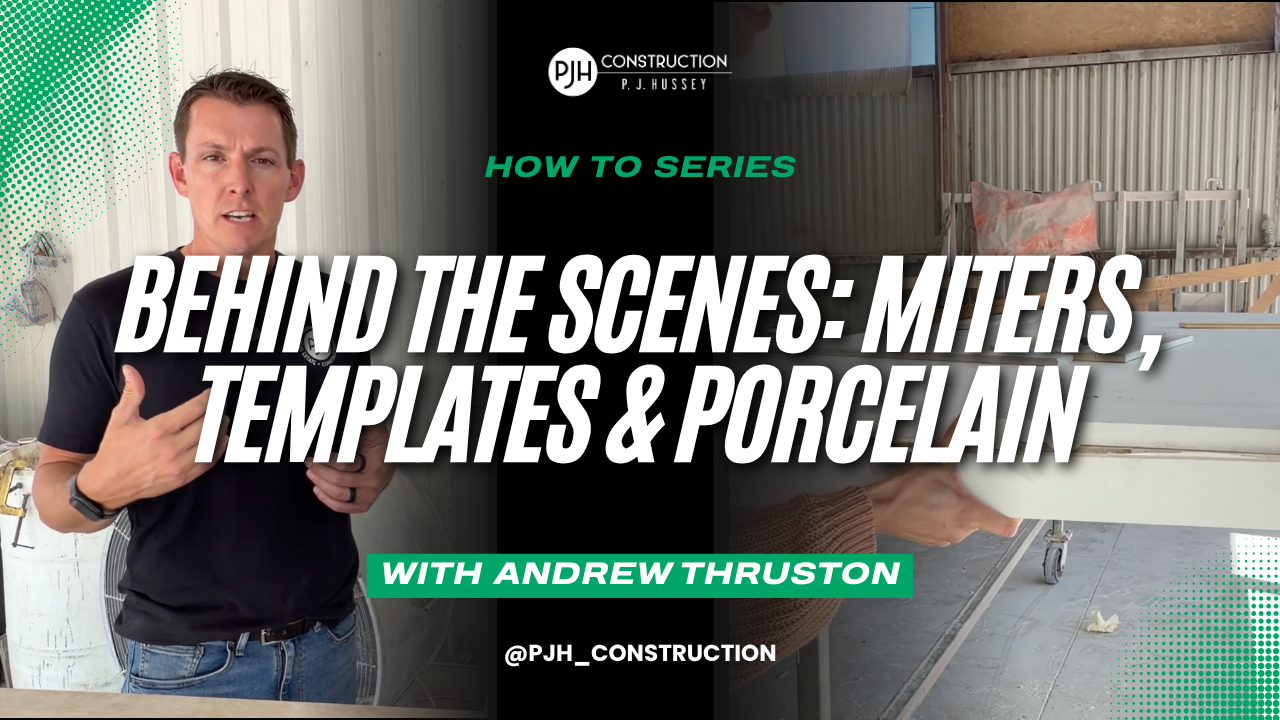
How Luxury Countertops Are Made | Miters, Templates & Porcelain
Ever wonder why some countertops immediately feel more custom and high-end than others? In many cases, the difference comes down to fabrication details that most homeowners never see. One of the biggest factors is the use of mitered edge countertops, a process that creates a thicker, more seamless luxury appearance.
We recently visited B’s Granite & Marble with Sujey to go behind the scenes and walk through the countertop fabrication process. From templating and material layouts to porcelain fabrication and edge construction, there is much more involved than simply selecting a slab and installing it.
🎥 Watch the video to see the process in action.
Table of Contents
What Is a Mitered Edge Countertop?
A mitered edge countertop is created by joining two pieces of material together at a 45-degree angle. Instead of attaching a visible strip to the edge, the material folds downward so the pattern and veining continue naturally.
This fabrication technique creates the appearance of a much thicker countertop while maintaining a clean, modern look.
Mitered edges are commonly used in:
- Kitchen islands
- Waterfall countertops
- Modern kitchen remodels
- Bathroom vanities
- Porcelain countertop applications
Because the veining continues over the edge, homeowners often choose this style when they want a more seamless and premium finish.
Mitered Edge vs. Standard Lamination
Another fabrication method commonly used is lamination.
Traditional lamination adds an additional piece of material beneath the countertop edge to create a thicker profile. While this method can still achieve a beautiful result, it may leave a subtle seam line depending on the material and design.
Mitered edges are often selected when homeowners want:
- Continuous veining
- A cleaner appearance
- Modern design aesthetics
- A luxury look and feel
Both fabrication methods can produce excellent results, and the right option often depends on your material selection, project goals, and overall design style.
Why Porcelain Countertops Require Specialized Fabrication
Porcelain has become increasingly popular in kitchen and bathroom remodels because of its durability and design versatility, but it also requires specialized fabrication equipment.
Unlike many natural stone materials, porcelain is thinner and more delicate during the cutting and fabrication process. Precision is extremely important because even small errors can affect the finished product.
Specialized fabrication equipment helps with:
- Accurate measurements
- Precision cuts
- Better consistency
- Reduced material waste
- Cleaner finished results
For homeowners considering porcelain, working with experienced fabricators can make a major difference.
Why Countertop Templating Matters
Before fabrication begins, the countertop space goes through a process called templating.
Templating creates an exact layout of the installation area so fabricators can build countertops to fit the space precisely.
One detail many homeowners do not realize is that walls are rarely perfectly straight. Even minor variations can create gaps if measurements are not captured correctly.
Templating accounts for:
- Uneven walls
- Curves and inconsistencies
- Sink locations
- Appliance cutouts
- Backsplash details
- Edge profiles
Think of it like creating a blueprint that will later be recreated in stone.
Material Planning Helps Avoid Costly Problems
Another important part of countertop fabrication happens long before installation day.
Material layouts help determine exactly how much slab material is needed while preserving natural veining and reducing unnecessary waste.
For specialty materials or limited-stock products, fabricators may place an additional slab on hold as backup without requiring homeowners to immediately purchase extra material.
Proper planning helps:
- Prevent delays
- Preserve design consistency
- Avoid unnecessary material purchases
- Reduce project surprises
The Details Behind Luxury Countertops
When homeowners think about countertops, most focus on color, material, and style. But much of what creates a premium finished appearance happens during fabrication.
Mitered edges, templating, precise layouts, and specialized fabrication techniques all contribute to the final result.
These behind-the-scenes details often make the difference between a countertop that simply works and one that feels completely custom.
Frequently Asked Questions
Are mitered edge countertops worth it?
Mitered edge countertops can be a great option for homeowners looking for a thicker, more seamless luxury appearance.
Can porcelain countertops use mitered edges?
Yes. Mitered edges are commonly used with porcelain materials to create a larger profile without using a thicker slab.
How long does countertop templating take?
Templating appointments are typically quick, although timing depends on project size and complexity.
Do countertop measurements account for uneven walls?
Yes. Templating captures wall variations so countertops fit more precisely during installation.
Ready To Upgrade Your Countertops?
Whether you’re planning new countertops, a kitchen remodel, or a complete home renovation, our team can help guide you through the process from estimate to installation.
Share this article
Follow us
A quick overview of the topics covered in this article.
Latest articles
October 17, 2026
October 17, 2026
October 17, 2026